
Most people have never heard of Gradyent, yet the Dutch company's software helps keep several European capitals warm. It is an excellent business. Whether its Series B was a good investment is a separate question, and the more interesting one.
What growth rate and exit value does Gradyent need to return 3–5x on its €28M Series B, and can a company selling to slow-moving district heating utilities get there within its investors' fund horizons?
Selling Heat at Glacial Speed
I was raised in the shadow of a glacier. It was the one thing in my childhood that never seemed to move - white, silent, always there above the rooftops. Today it is leaving, a little more each summer, and watching it go feels like watching home itself come undone, a farewell spoken so slowly I almost missed that it had begun.
I have come to see it this way: "A glacier is a display window for everything the market has broken."
We are told that capital and climate pull in opposite directions, that every gain for one is a loss for the other. I have never accepted that. The same market that broke the glacier can learn to mend, if its growth is put to work for humankind.
But conviction is the easy part. The test lies in the particulars, so this is the story of one company, one funding round, and a theory I carried down from the mountains.
Every investor has a favourite theory. Mine is about ice, and it is more useful than it sounds.
The glacier taught me how slow things behave. Nothing about it was quick, and nothing about it was weak. It built itself one winter at a time, and it was there every morning. Years later I found the same temperament in an unlikely place: software sold to utilities. It is the slowest money in technology. It takes years to sell and decades to dislodge, and it grows heavier every winter as each customer adds one more module. I call these companies glaciers.
Glaciers are wonderful to own and awkward to back. Venture capital pays for speed, ice pays for patience. I wanted to watch that tension play out inside a real European company, at the moment an investor has to choose.
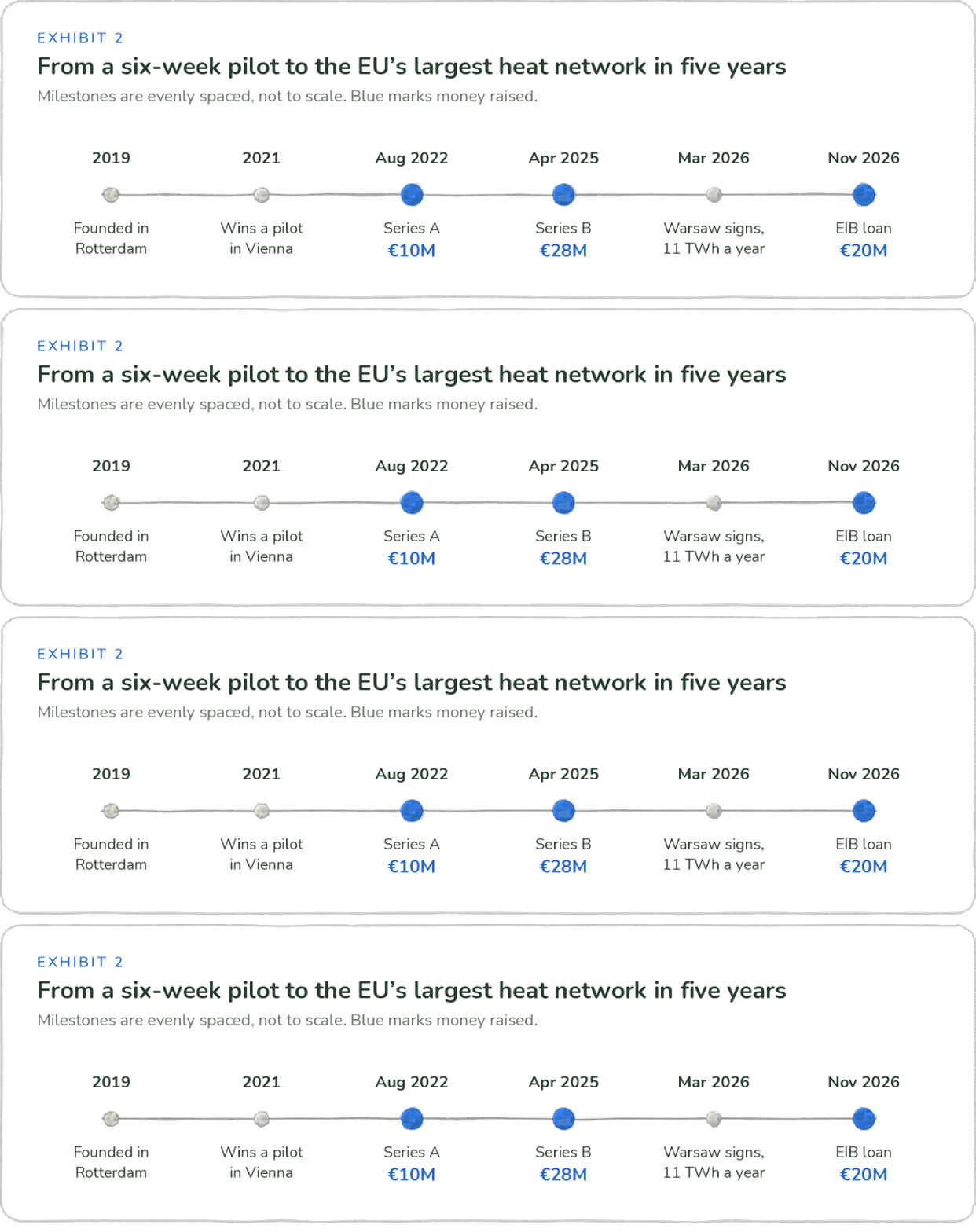
So I picked Gradyent. It builds digital twins of district-heating networks, the pipes that carry hot water beneath European cities, and in April 2025 it raised a €28M Series B. It is a glacier whose business is warmth.
The title is a joke with a point, and the joke is partly on me. Glaciologists call a glacier warm-based when meltwater at its bed lets it slide instead of creep. The same meltwater I grieve on the mountain is what I go looking for in a company. It is still ice. It just moves.
So the question is this: can Gradyent move fast enough for its Series B to earn a venture return?
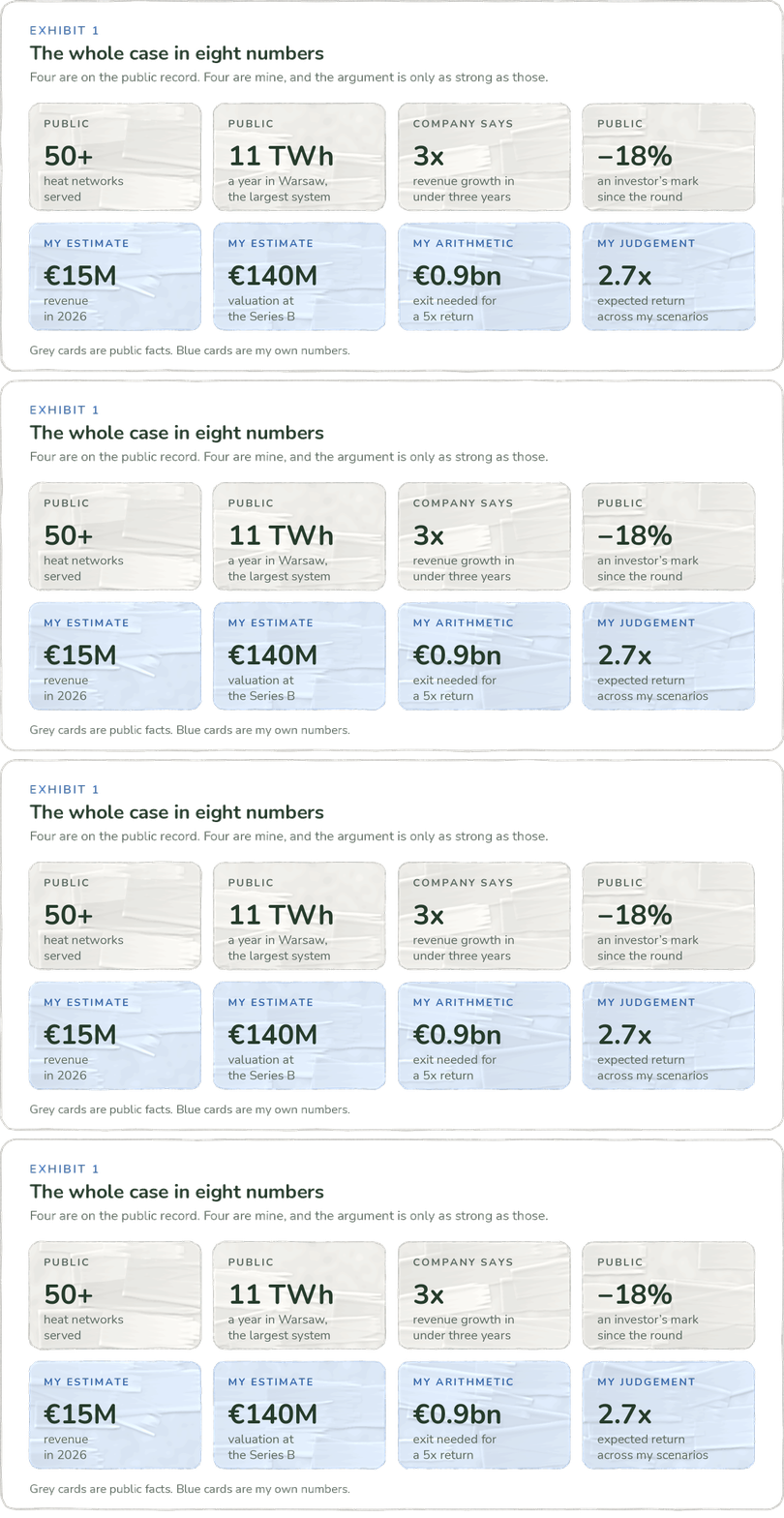
The short answer: it is a real glacier, and it is not yet fast enough. On my numbers, the round needs an exit near €0.9bn to return five times the money, and nobody has paid that for a company like this. One of Gradyent's own investors already values its shares 18% below the round price. Across three scenarios, I expect about 2.7x.
The rest of this piece is the long answer.
The Company In One Minute
Gradyent sells one thing - a live copy of a heat network that an operator can experiment on. The twin joins pipe maps, weather and meter data to a physics model. You try the change in software first, then in steel.
Helsinki shows why that matters. The city's utility, Helen, modelled its whole system in the twin, and the analysis helped it close a coal plant. Nobody shuts a power station on the strength of a spreadsheet. That is what I mean by a market learning to mend.
Three founders started the company in Rotterdam in 2019: Hervé Huisman, Robert Vrancken and Freek Smelt. It now employs more than 150 people and serves more than 50 networks.

Is It A Glacier?
A glacier needs three things: snow that settles, layers that stay, and pressure that turns snow into ice. I went looking for each at Gradyent.
Accumulation
The first snow fell in Vienna. In 2021 Gradyent won a Wien Energie innovation challenge by building a twin of one small network in six weeks. Vienna has nearly 600 networks like it.
Five years later the company is modelling Warsaw, the largest heat system in the EU. It says revenue tripled in just under three years, which is 45% to 48% a year.
I did not expect that pace from a company whose customers are city utilities. I also cannot check the level, because no revenue figure has ever been published.
Layers
A glacier's layers are its history. Gradyent's are unusually easy to read, because its customers are named in public.
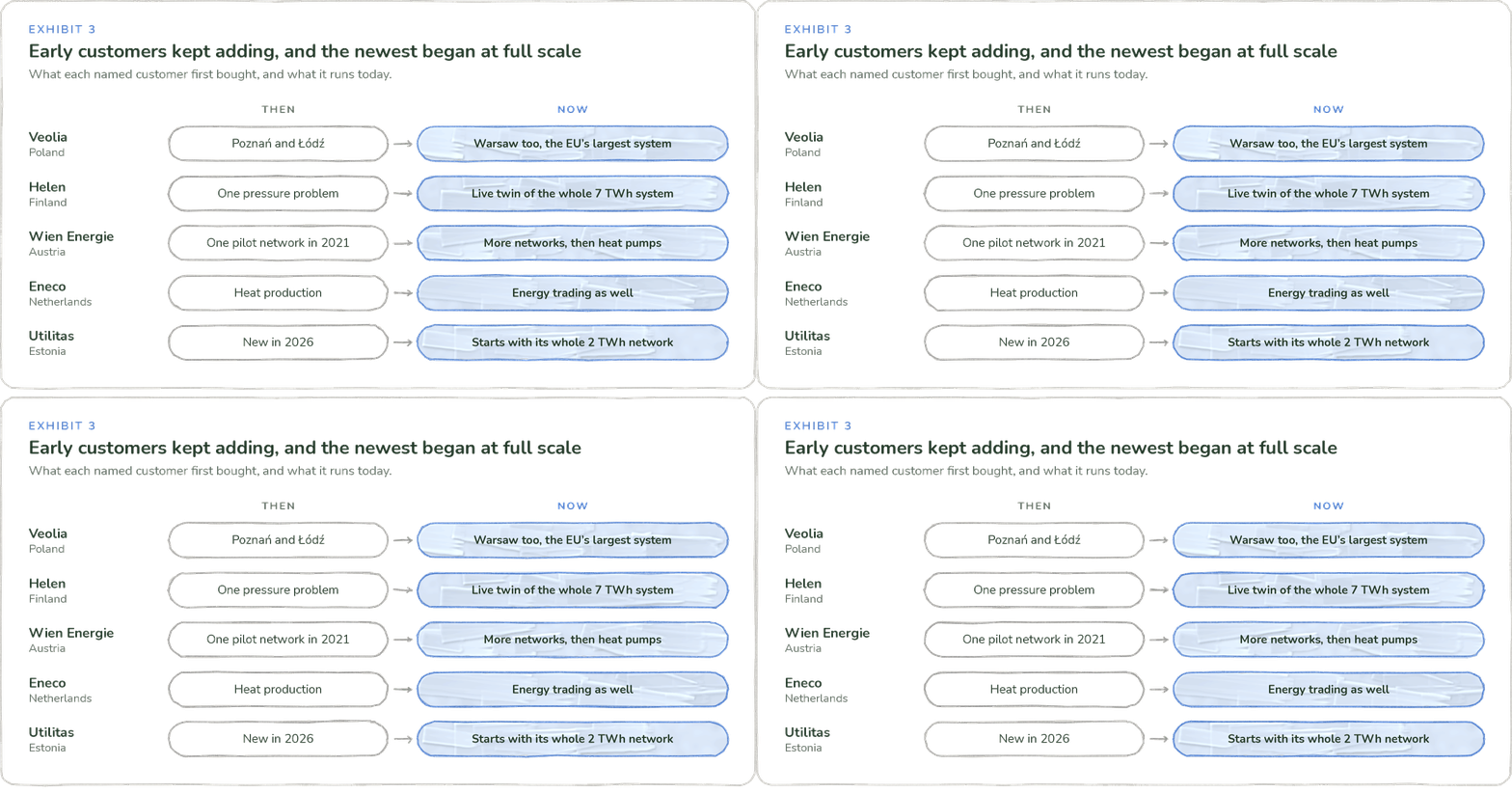
This is the exhibit that convinced me. Every older customer I could trace has widened its use over time. Nobody bought once and stood still.
Two caveats belong beside it. The base is concentrated: three systems carry 20 TWh a year, about 4% of all the district heat in Europe. And two customers, Eneco and Helen, are also shareholders.
They invested after using the product, which is the best reference a company can have. They are also not arm's-length buyers.
One rival has an easier way through the door. Danfoss supplies much of the hardware in these networks and sells its own optimisation software. A utility can buy a version of this product from a supplier it already pays.
Compression
Pressure turns snow into ice, and in software the pressure is revenue per customer. Gradyent does not publish revenue, so I estimated it three ways.
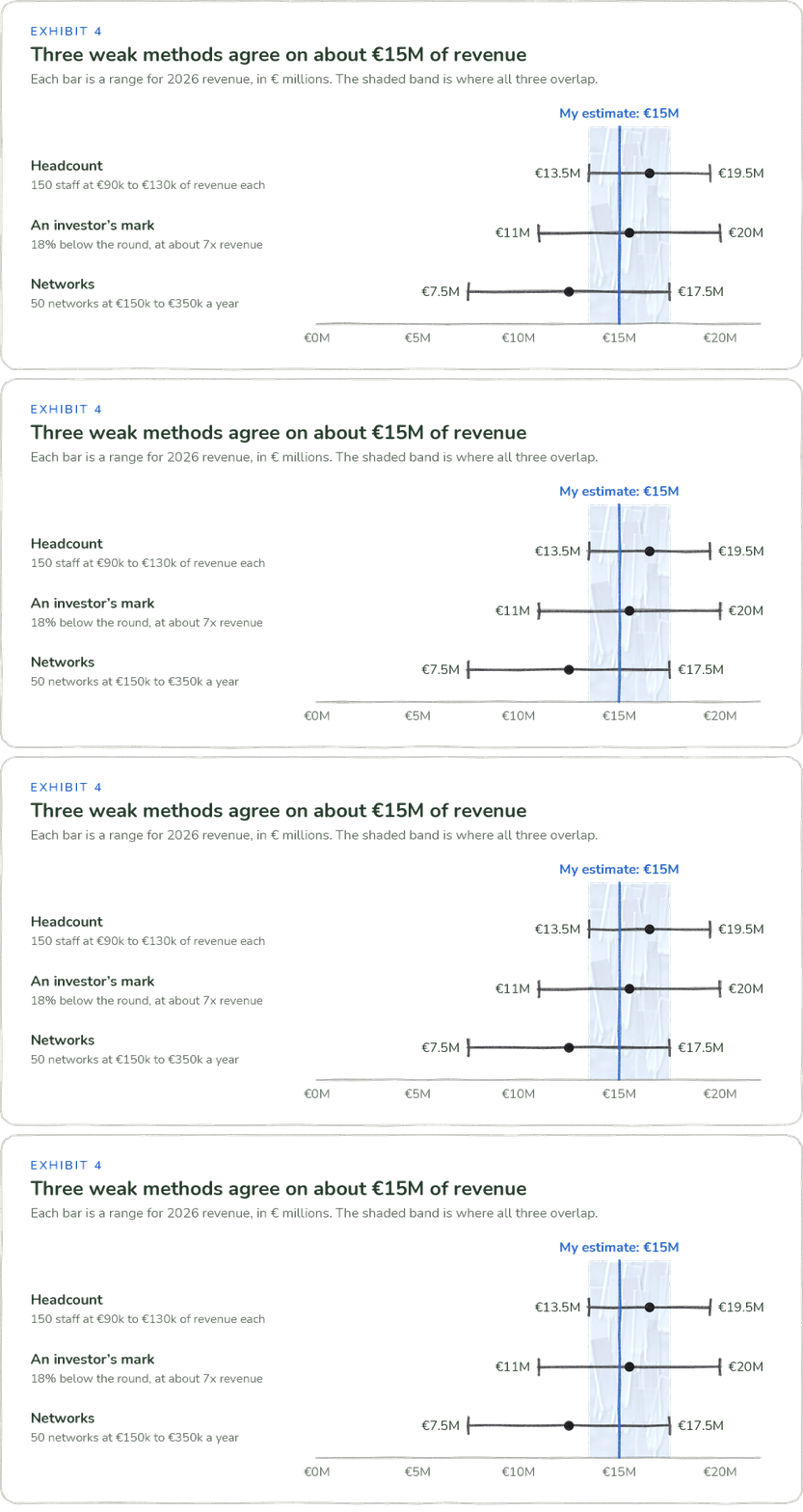
No single method deserves much trust. Three weak methods that agree deserve a little, and they agree on about €15M.
From there I can guess at price. The three named systems carry 20 TWh, and I assume the whole base is 30 to 45 TWh. That is roughly €0.40 per MWh of heat. It is the number I trust least, and the whole case turns on it.
Is €0.40 a lot? Gradyent has said its customers save 5% to 10% of fuel cost. Danfoss claims 1% to 3% for its rival product. Take 2% and a fuel cost of €40 per MWh, and the saving is €0.80.
So Gradyent charges about half of a cautious estimate of what it saves. That is either room to raise prices or a sign that the saving is hard to prove.
One small number rearranged my thinking. Wien Energie estimated that optimising its 20 largest small networks would save up to 4,000 MWh of heat. At €40 per MWh that is €160,000.
The money is not in small networks. It is in whole systems such as Warsaw, where the twin also schedules production and trading.
So, is it a glacier? Yes. Customers expand for years, and I found none that left. It is a small one, at about €15M of revenue, but the ice is real.
Can It Move Fast Enough?
The Surge
A glacier surges when something reduces the friction beneath it. Three things are doing that for Gradyent.
Heat networks are getting complicated. Utilities are swapping one big fossil plant for heat pumps, electric boilers, storage and waste heat. A network with many sources cannot be run on control-room habit.
Electricity prices swing. A utility with heat pumps chooses hour by hour whether to make heat from power or from fuel. That is why Eneco now uses the twin for energy trading.
Public money is flowing. The European Investment Bank has approved more than €2bn for district-heating modernisation in two years, and its loan to Gradyent comes from the same policy.
Here is my caution. The surge is in what utilities need, not in how fast they buy. Wien Energie took four years to go from one pilot to a programme. A warm glacier slides. It does not sprint.
The Valley
A glacier is only as large as the valley that holds it. Gradyent has said it wants to help 1,000 heating networks. I think that counts the wrong thing.
Europe has about 16,000 district-heating networks supplying about 496 TWh a year. The average one is 31 GWh, a rounding error beside Warsaw's 11 TWh. So I rebuilt the market in heat, not in logos.
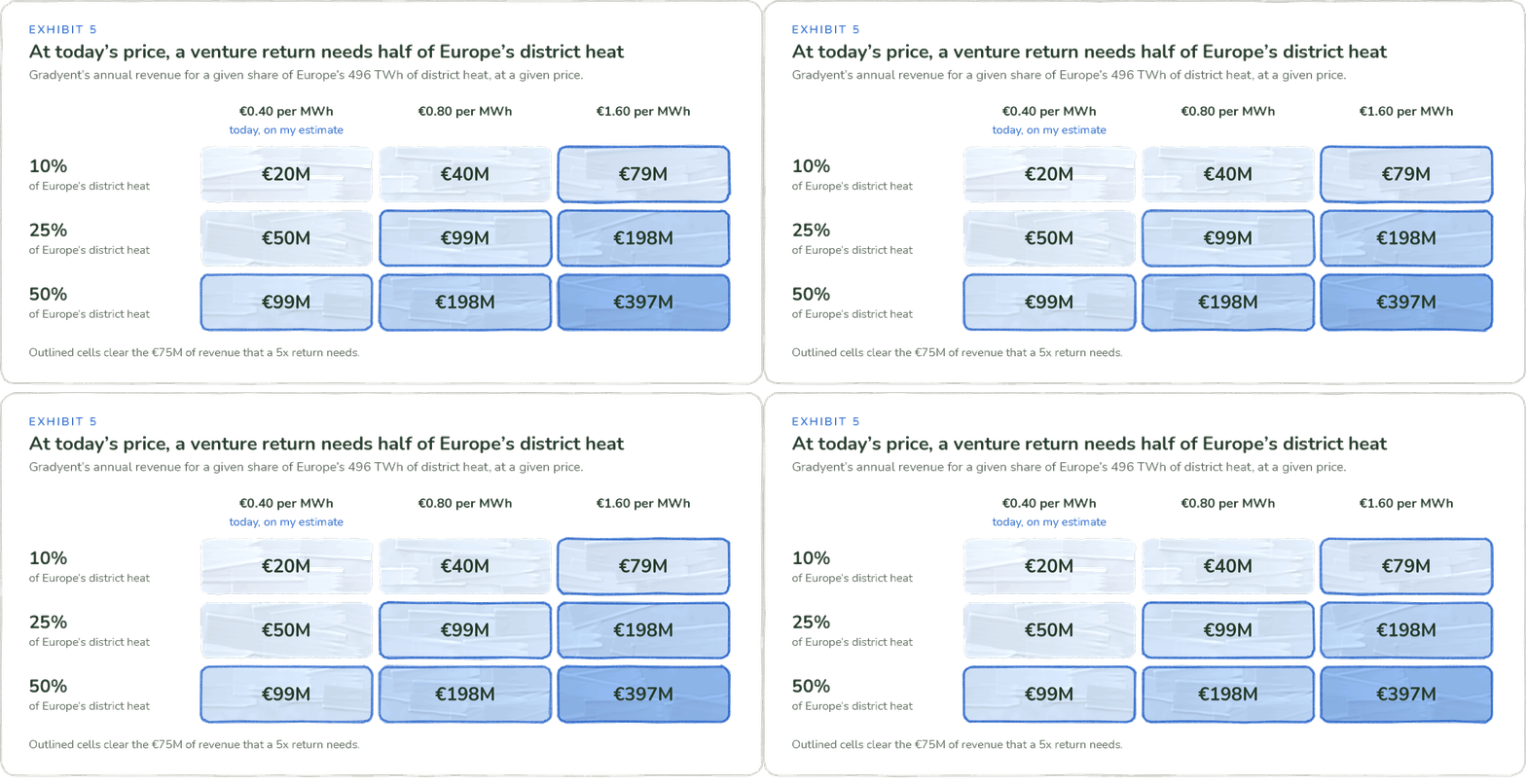
Part 3 will show that a venture return needs roughly €75M to €110M of revenue. At today's price, on my estimate, that is 40% to 55% of all the district heat in Europe.
This grid changed what I think the round is betting on. I expected a bet on winning more networks. It is a bet on earning more per MWh, or on markets beyond district heating such as industrial steam.
The first of those is harder than it looks. Doubling the price would swallow the whole of a 2% fuel saving. The price can only rise if the product saves well over 2%, which is what Gradyent claims and Danfoss does not.
So, can it move fast enough? The growth record says yes. The market says not at today's price. All of European district heating is worth about €200M a year to Gradyent.
What Does The Round Need?
What The Round Paid
Gradyent did not disclose a valuation, and I would rather be roughly right than silent. A Series B usually sells 15% to 25% of a company, which is my assumption. For €28M that implies €112M to €187M after the money, and I use €140M.
Then I found a way to check, and it became my favourite source in the whole exercise. Quest for Growth is a fund listed in Brussels and managed by Capricorn Partners, a Gradyent shareholder since 2020. It owns Gradyent shares, and a listed fund has to tell the public what it thinks they are worth.
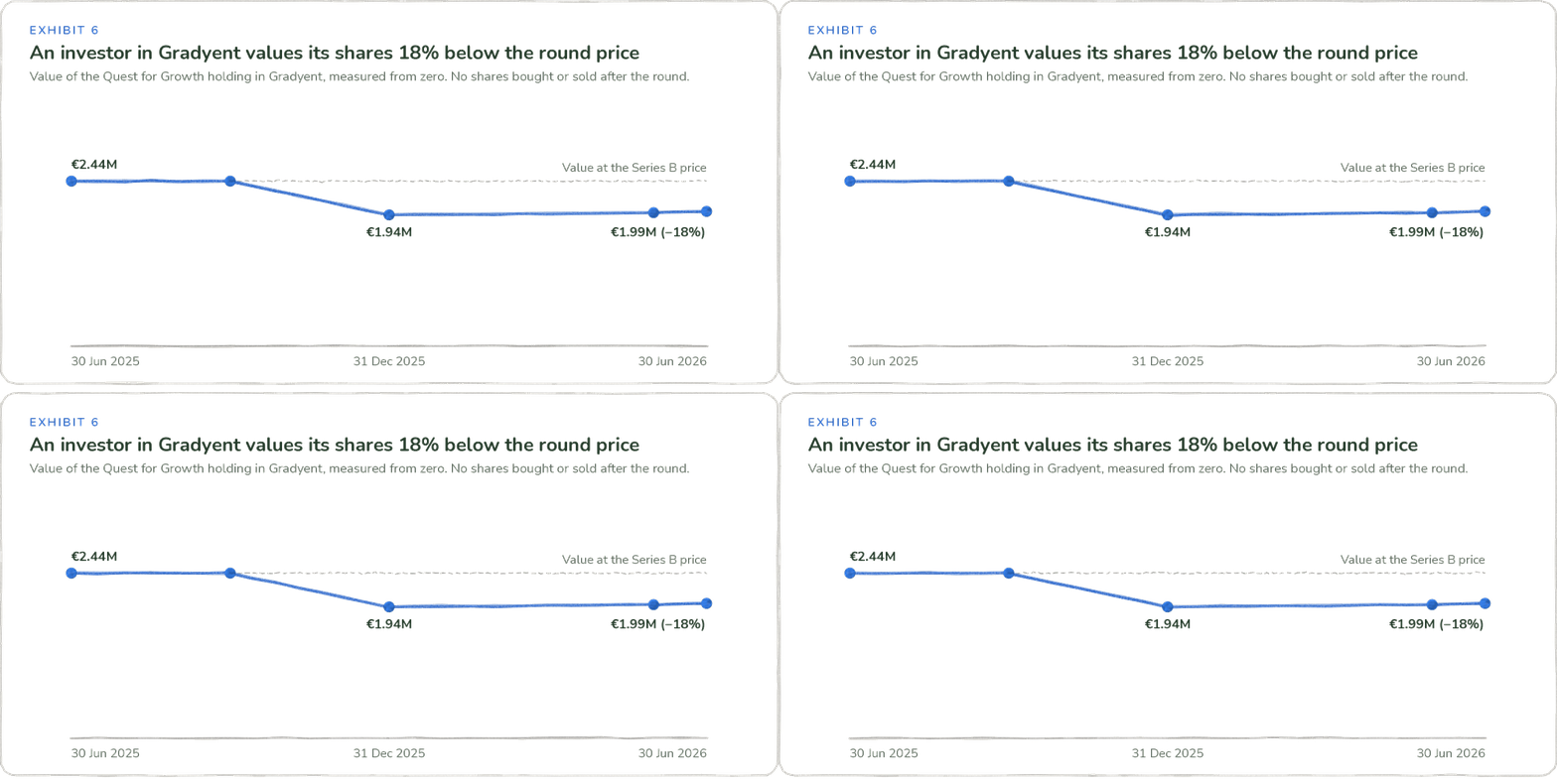
The fund put €1.55M into the Series B and carried its holding at €2.44M afterwards. By the end of 2025 it carried the same shares at €1.94M, and at 30 June 2026 at €1.99M.
This is no outsider's guess. The fund's manager has backed Gradyent since 2020 and invested again in the round. It values the holding on the revenue multiples of listed peers, and its own sensitivity table implies about seven times trailing revenue.
Seven times my €15M is €105M, plus cash. My €140M less 18% is €115M. Two estimates built from opposite ends meet in the middle, and that is the best cross-check I have.
What The Exit Must Be
A Series B investor is diluted by later rounds, and lenders are paid first. I assume one more round that sells 20%, and I subtract the €20M loan from every exit. The return is the exit value less €20M, divided by €140M, times 80%.
I use 5x as the bar for a venture return and 3x for a growth investor. That means an exit of about €545M for 3x and about €895M for 5x.
Now set that against what buyers have actually paid for software sold to utilities. Itron bought Urbint and Locusview, and IFS bought Copperleaf.
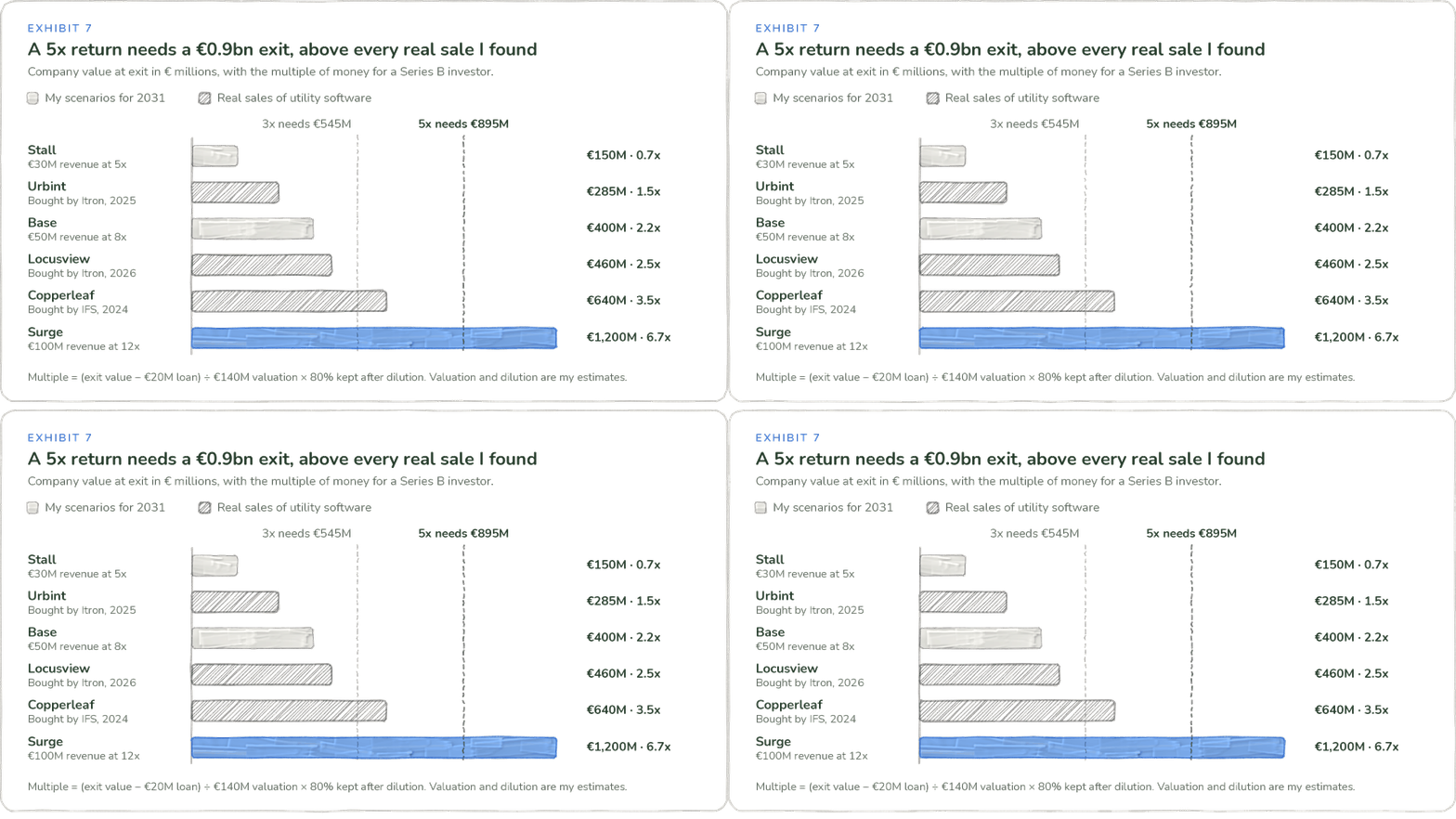
I built three scenarios for 2031, six years after the round.
- Stall. Revenue reaches €30M, growing 15% a year, and the company sells at 5 times. The investor gets back 0.7x.
- Base. Revenue reaches €50M, growing 27% a year, and the company sells at 8 times. The investor makes 2.2x, about 14% a year.
- Surge. Revenue reaches €100M, growing 46% a year, and the company sells at 12 times for €1.2bn. The investor makes 6.7x, about 37% a year.
The base case is a good company and a dull investment. It would sell for about what Itron paid for Locusview, and it only doubles the money in six years.
The surge surprised me, because it is not a fantasy. It asks Gradyent to keep growing at the rate it says it has already achieved, for five more years. It also asks for something no peer has done: €1.2bn of value twelve years after founding.
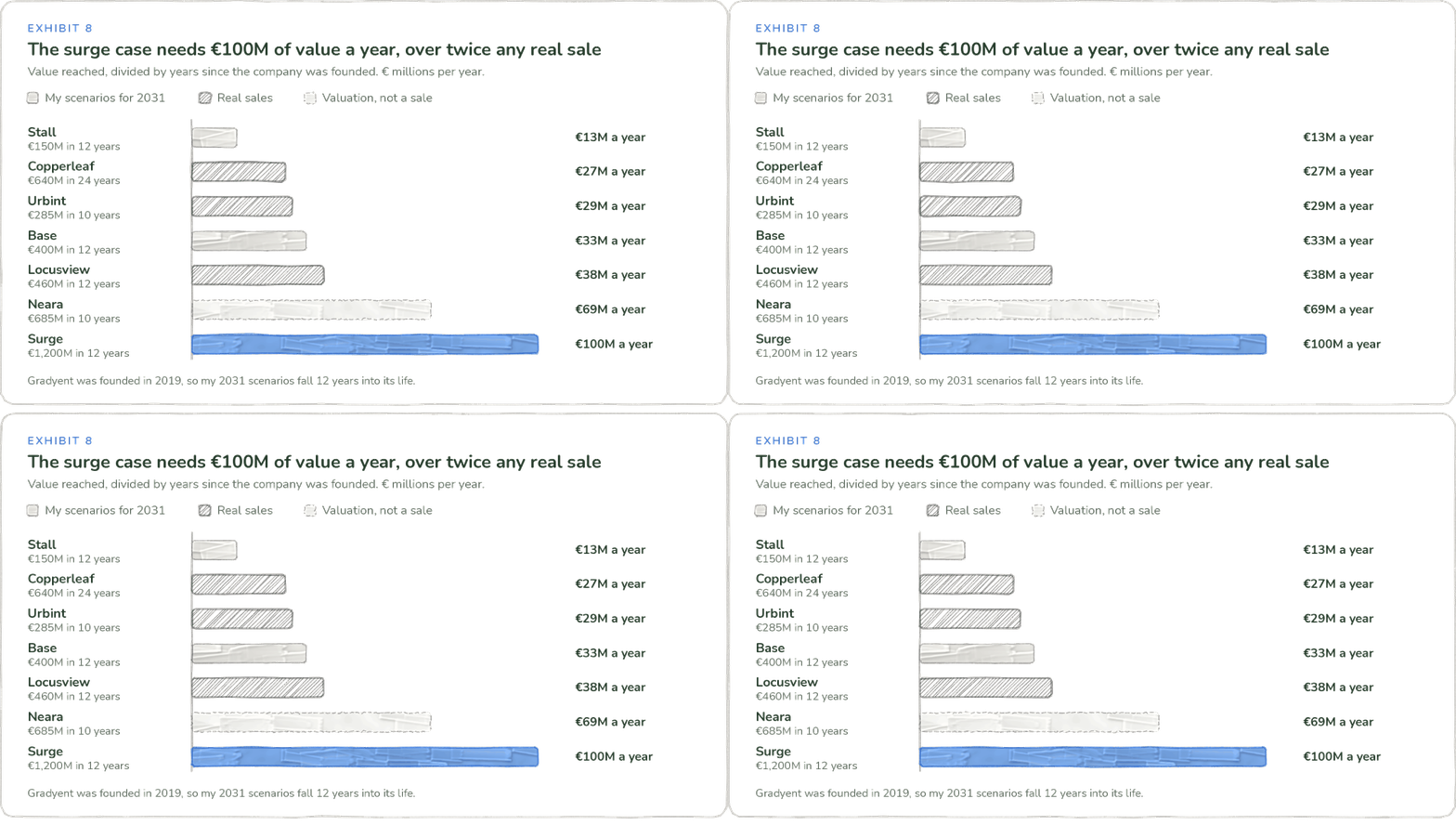
That exhibit holds two warnings. Every real outcome took a decade or more. Ten years for Urbint, about twelve for Locusview and twenty-four for Copperleaf. Neara's figure is a funding valuation, not a sale.
The multiple has moved too. Itron paid about 12.6 times that year's revenue, while an informed holder applies about seven times today. That gap is the multiple risk in this investment.
What I have to believe. One scenario is not a return, so I weight all three: 30% stall, 50% base, 20% surge. Those odds are my judgement and nothing more. They give about 2.7x, or roughly 18% a year.
For that to reach 3x, the surge would need to be a little over one-in-four likely. The growth record argues for more than my one in five. The fund's mark argues against, because an insider is not valuing these shares as if the surge were under way.
All of it rests on my €140M. At €112M the exit needed for 5x falls to about €0.7bn, and at €187M it rises to about €1.2bn.
Crevasses
Crevasses open where ice is stretched faster than it can flow. Six things could stretch this investment the same way.
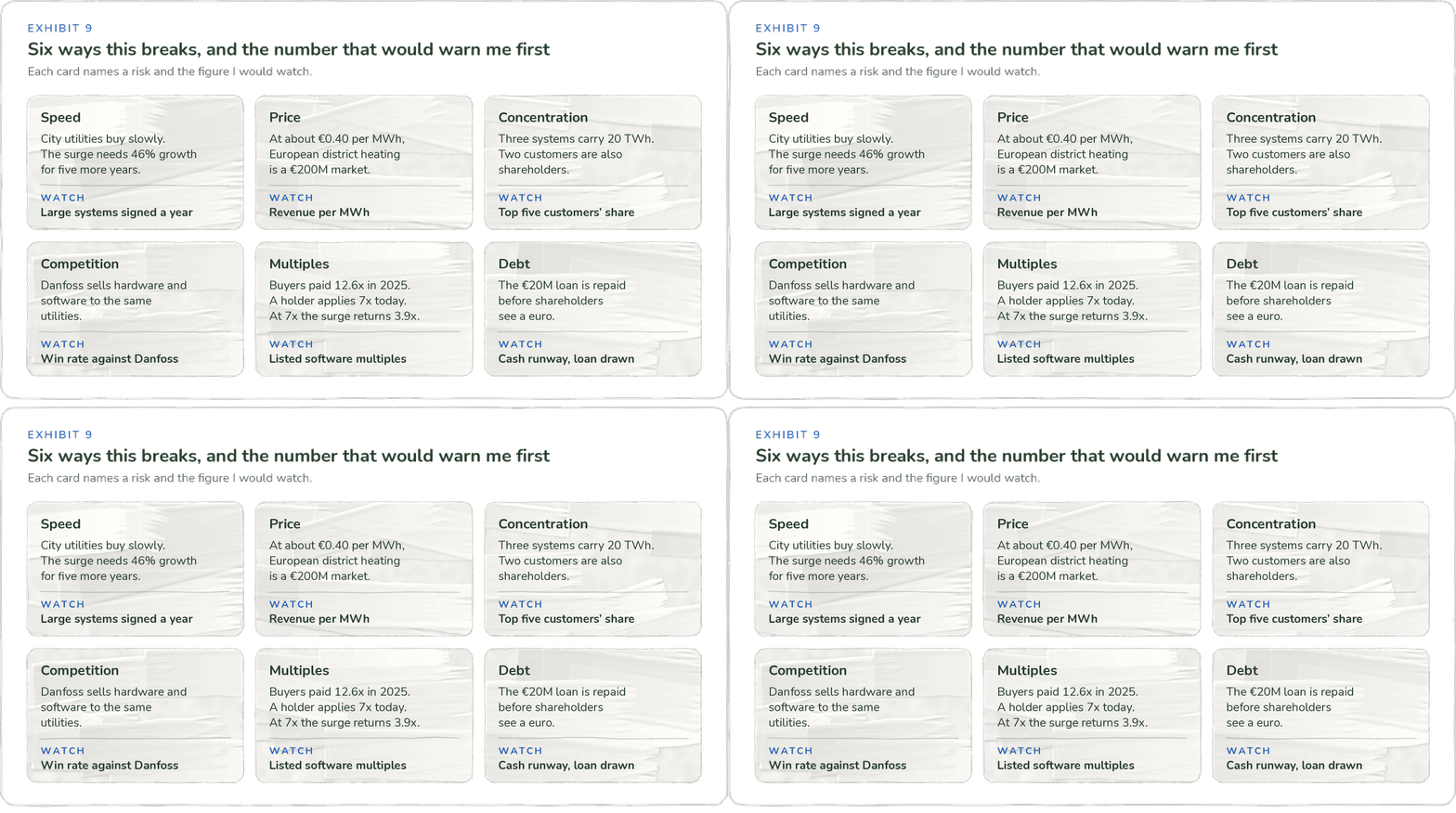
The seventh risk is me. If the true valuation was €112M, every return here rises by a quarter. If it was €187M, every return falls by a quarter.
The Case Against My View
The people who led this round presumably disagree with me. So does the bank that has just lent €20M. Their case deserves its best version.
The growth is real, and the surge needs the same pace, not a faster one. The customers keep getting bigger: Warsaw alone is worth hundreds of average networks. Accounts expand without a new sale, as Eneco's move into trading shows.
And the loan means less equity has to be sold while the fund's mark sits below the round.
The first point persuades me most. It is why my surge is a continuation and not a miracle. What holds me back is the price per MWh, which nobody outside the company can see.
Conclusion
Gradyent is a real glacier, and a warm one. Customers stay and expand, and the company says revenue tripled in under three years. But on my estimates the Series B needs an exit near €0.9bn to earn 5x, which no comparable company has reached, and an investor inside the company already marks the shares 18% below the round. I expect about 2.7x.
So the answer comes in two halves. The business is what I hoped to find when I went looking for a glacier. The round is a sound growth investment and a hard venture one.
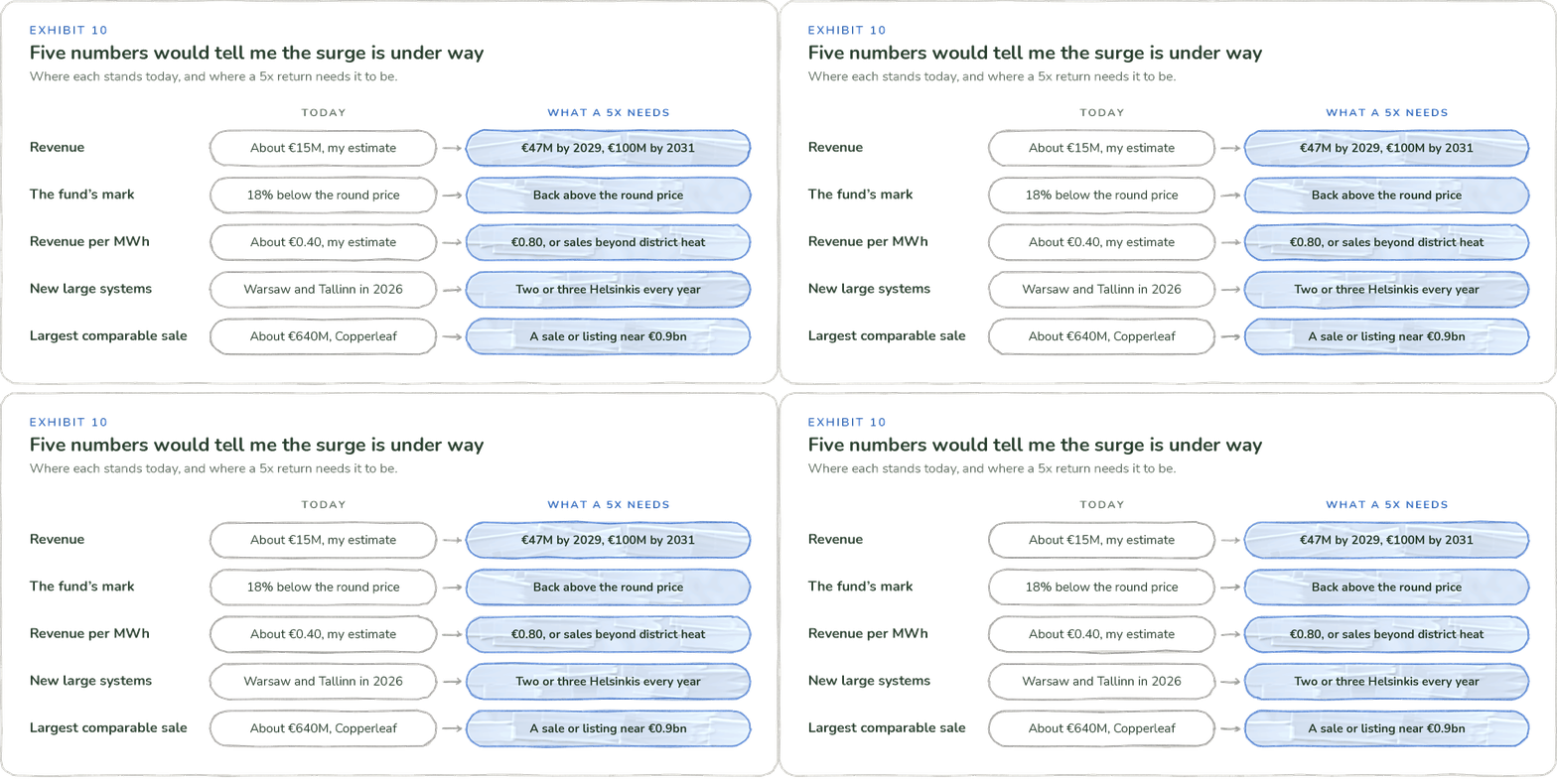
Three things would change my mind. The first is the fund's mark climbing back above the round price. The second is an independently measured fuel saving of 5% or more at Warsaw or Helsinki. The third is a disclosed valuation near €110M.
Public data cannot answer the questions that matter most. With access to the company, I would ask four.
- What is revenue today, and how much of it is recurring?
- What does each customer pay per MWh, and how did that change as it added modules?
- What fuel saving has each large customer measured, and who measured it?
- What were the Series B valuation and its liquidation preference?
What I take from this is a habit. I set out to write about heat and ended up reading a Belgian fund's holding tables. The most useful number in this article was in no press release.
I now ask who is obliged to disclose before I read what a company chooses to disclose. I also see my own theory more clearly. The slowness that protects a glacier is the same slowness that makes it hard to back.
I began with a glacier that is leaving because the world warmed faster than ice can move. Gradyent has the opposite problem. It has to move faster than ice is supposed to, in a market that still buys at the pace of a city council.
I hope it does. Software that trims the fuel burned under Europe's cities is what I mean by a market learning to mend. But hope is not a price.
A warm glacier slides faster than a cold one. It is still ice, and this round was priced for water.
Disclaimer - This is an analysis of public information as of November 2026. Gradyent is a private company and has not published its revenue or valuation, so the key figures here are my own estimates and may be wrong. It is not a recommendation to buy or sell anything.
Gradyent - Upgrade your Heating grid with our powerful Digital Twin
By enabling you to optimise, decarbonise and transform your Heating system, we help you to take on the climate challenge and progress.
 Upgrade your Heating grid with our powerful Digital Twin